Monday, July 9, 2012

Successful Summer Hiking with Kids


Summer is the perfect opportunity to explore the great outdoors with your children and the experts at Washington State trails have some great advice and resources to maximize fun, safety and learning!

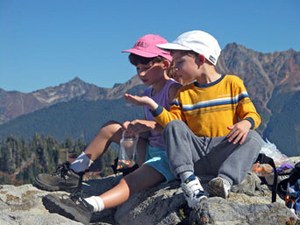
You don’t need to pack your hiking gear away when you have kids!  Hiking is a fantastic way to combine quality family time with exercise and exploration of the natural world. If you were an avid hiker before children, hiking to you may have meant how fast you can hike, how far you can go, or bagging peaks.  Warning:  Hiking with children of any age is different in many ways.But this post will provide some great tips and tools to get you started.


Planning

First, you need to get your head in the 'hiking with kids' zone. It takes a little more planning to have a successful trip when little ones are along. Some suggestions:
  • Modify your goals:  You may not reach the end of the trail. You may not even hike a mile! Be prepared to adjust your hike to the enjoyment and comfort level of children.  
  • Pack patience and flexibility:  If you see a frog dart across the trail, be prepared to stop and wait to watch for that frog to dart across the trail again. Use teachable moments to explore the natural world.
  • Know what features are ahead:  For starter day hikes, choose short trails that do not have much elevation gain, but do have features like lakes, ponds, or waterfalls along the way. Children are fascinated with water.
  • Dress for success:  Check weather conditions before you head out the door. Children get cold much easier than adults, especially if they get wet.  Be ready with an extra change of warm clothes.

What makes a good hike with children?

 A good hike is one that appeals to a child’s sense of exploration and adventure. Every trail has some kind of adventure in it.
  • Look for discoveries along the way. Bring a magnifying glass and kid-friendly field guide. 
  • Teach kids to be good observers by looking for signs of wildlife (feathers on the ground, claw scratches on tree trunks, animal tracks, bird holes in dead trees, fur along the trail, slugs. Water striders on lakes, sand dollars along the beach, frogs in pond).
  • Choose a trail with features that interest kids as destinations or turnaround spots.
  • Remember a child’s sense of time. Have patience when they stop to ask questions. They may be seeing their first trillium or woodpecker.
  • Put yourself in their boots. Their legs are short and it takes three of their steps for every one of yours. Let the kids set the pace.  
  • Call for rest stops before they ask for them and praise them for how well they are doing.

Other Tips and Tricks

  • Create a checklist of essentials to use over and over again:  First aid kit, sunscreen, bug spray, snacks, stuffed animal, extra clothes, special walking stick, etc.
  • Energy stops - As in “when we get to the big tree ahead we’ll need to have an energy stop.” Snacks provide great motivation to keep kids moving on trail.
  • Hike with a friend - as kids get older they would rather spend time with friends than with their family. Allow your child to invite a friend along. They can share a fun experience and entertain each other. 
  • Rotate leaders - When hiking with more than one child make sure that everyone gets to be a leader and set the pace.
  • Keep kids occupied - visit our Keep Kids Entertained on Trail page for ideas!

Friday, July 6, 2012

Positive Discipline Strategy: Control vs. Cooperation

Are you trying to gain control over children or with children? Trying to gain control over children is hard. It takes constant effort. You have to be very vigilant to police the action of children so you can implement your control tactics—usually punishment and rewards. You have to catch children being “good” so you can reward them and catch them being “bad” so you can mete out the punishment. It never ends—and what happens when you are not around? If you are very good at being in control over children what have they learned? Have they learned self-discipline, respect for self and others, responsibility, problem-solving skills, cooperation?

Trying to gain control over children is disrespectful and greatly decreases your chances of winning cooperation. Disrespectful methods invite distance and hostility, rebellion, revenge, sneakiness to avoid getting caught, or, worst of all, a child’s developing belief that, “I am a bad person.” On the other hand, respectful methods invite closeness, trust, and cooperation.

Winning Cooperation


 The best way to make a connection and win children over is to be respectful. One of the best ways to be respectful is to “get into the child’s world” and express understanding of the child’s feelings. Showing empathy is not the same as condoning. A really nice touch is sharing a time when you might have felt the same. These are the steps to create the connection to increase the chances that you can work for correction because children are likely to listen to you AFTER they feel listened to.

Correction Does Not Involve Punishment

In can be so difficult for parents and teachers to think they are not doing their job if they don’t engage in a lecture or some kind of consequence (usually a poorly disguised punishment). This will take you right back to the consequences (resistance and/or rebellion) you will experience by trying to gain control over instead of with your children. What do children learn when they are respectfully involved in finding a solution that works for everyone? Thinking skills, problem-solving skills, respect for self-and others, self-discipline, responsibility, listing skills, motivation for following the solution they have helped create. The list could go on and on. And, what better way to achieve control with, and to win cooperation. Once you have achieved a connection you have created an atmosphere where you can focus on a solution together. You have won cooperation.

Friday, June 29, 2012

Wallowa County Finalist for National Honor

Two BHF Staff and a community partner will travel to Denver to attend a conference and awards ceremony for the 2012 All America Cities Award.  Each year, 10-12 communities from around the Country are honored with this prestigious accolade in areas ranging from community health to education.  This year's award focuses on communities working together to improve 3rd grade reading scores for all students.  After submitting a Letter of Intent in November, BHF was invited to collaborate with school districts and community partners to present a Community Solutions Action Plan in early spring for further consideration.  In late may, BHF was notified that Wallowa County had been selected as 1 of 32 national finalists to attend the conference in Denver.  To read more, read our guest blog on the Early Works blog of the Oregon Children's Institute.

http://early-works.org/blog

Friday, June 22, 2012

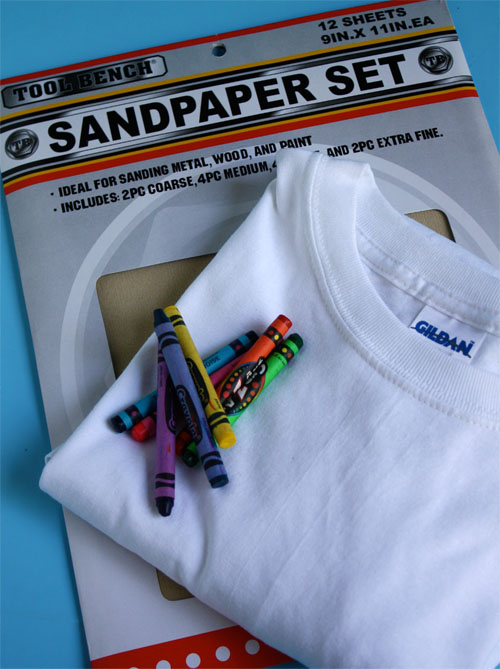
Sandpaper T-shirt Art


Both students and teachers were thrilled with this easy, inexpensive way to capture kids art!   Sandpaper serves as the transfer paper and with the help of an iron, turns a simple crayon drawing into a cute, unique t-shirt.  Simply follow the steps from alphamom.com and start crafting today!

1. Color a fun design on the sandpaper. Remind children that the image will be reversed. Once the design is colored go back over the design giving the sandpaper an extra thick layer of crayon.

2. Place a piece of cardboard inside the t-shirt to keep the design from bleeding through to the back of the shirt. Position the sandpaper right side down on the t-shirt.

3. Place a piece of parchment paper or paper towel on top of the sandpaper to protect the iron. Iron, on cotton setting, the sandpaper for about 30 second. Gently lift one edge and make sure you have a good print before totally removing the sandpaper. Iron a bit more if you need to transfer more of the crayon.

4. Remove the sandpaper. You’ll have a print with loads of cool texture–not to mention a new darling t-shirt.

5. To set the color, place a couple of paper towels on top of the design and iron. This will remove some of the extra wax. Toss t-shirt in the dryer for about 20 minutes to set the color. Launder by itself the first time.

Monday, June 18, 2012

Creative Summer Craft

A creative way for kids to use the stones they stumble across is to turn them into animals, people, or objects.
With just a few supplies -- paint, glue, and clay -- children can try out their skills as rock artists. Like sculptors, they'll learn to judge proportion and form. Like painters, they will need to consider color and shape, along with such pleasant dilemmas as how to create a tapered wing on a rounded rock.

Both tempera and acrylic paints work well (though tempera washes MUCH easier).  Have kids sketch out their idea first before applying paint to their rocks.

Here are some great ideas to get you started.

Wednesday, June 13, 2012

Creative Ideas for Hitting the Road!

While escaping from the daily routine may  sound like a fun idea, traveling with children can often make trips a bit less memorable than desired.  Building Healthy Families asked around and collected some favorite family travel tips for your next out of town adventure!  We would love more ideas and encourage you to add your own by commenting below.

  • WINDOW AS CANVAS If you don't mind wiping the windows, let the kids use dry-erase markers to color pictures. My kids love to play tic-tac-toe. A baby wipe clears it up fast -- makes the kids great travelers! 
  • PIPE CLEANERS We get lots of mileage out of a big bag of colorful pipe cleaners. Both my kids make different things out of them; the little one practices his colors and counting with them. Add some large beads and you're set. We use them on planes mostly. The kids make things for the passengers and everyone seems happy
  • TOYS BY THE HOUR I go to the dollar store for little things for them to play with, then wrap them up and give the kids their own backpacks with the presents inside. They can open one every hour and enjoy a new surprise. 
  • NIGHTTIME TRAVEL Even if it is a baby toy, kids have fun with ANYTHING that lights up. Our dollar store has neon glow bracelets and sticks (the kind you'd purchase at an amusement park or nighttime parade) that kids can connect and make bracelets or necklaces out of. Glow-in-the-dark star stickers are fun to get out too. Have them use their mini-flashlights on them to get them to shine. They can stick them above their seat in the car (if they are big enough), or you can have them do it before it gets dark when stopping for gasoline or something quick
  • MAD LIBS We just finished a trip with a 6- and 8-year-old. The big hit of the trip was Mad Libs. The kids took turns filling in the answers and loved reading the funny stories. 
  • FREEZE 'EM FIRST Make mini banana-nut bread loaves, freeze, then thaw in morning and slice for snack; great with peanut butter and slice of banana on top ... Mix fruit or jam into yogurt and freeze in small, snack-sized Ziploc bags for frozen yogurt on the go. Cut a hole in the end of the bag for easy access/eating.... Make a batch of pudding and add coconut, nuts, marshmallows, crushed cookies, or sprinkles. Pour into molds. Freeze several hours until firm (stays nice as it thaws!)

Tuesday, May 29, 2012

Finding Health Information on the Internet


 It can be difficult for families to find credible, current information about healthcare online.  The following suggestions from CaCoon Health Notes are designed to help parents and professionals navigate the world of internet searching.

1. Look for an "About Us" section to see who owns the website.  Website addresses ending in "edu," "org," and "gov" are more likely to contain unbiased information.

2. Watch for Advertising.  Although some very good sites have advertising, many sites are trying to sell their own product.

3. Be a Skeptic.  Watch for sites that claim "miracle cures." If it seems to good to be true, it probably is not true.

4. Look for evidence.  If studies or people are mentioned, see if the papers are cited, or seek more information on the person/reports mentioned.

5. If you opt to "google" a specific condition, try searching for "health care guidelines for condition name" or "critical elements of care for condition name." These phrases are more likely to turn up credible information than simply searching the name of the condition alone.

6. Consult a reliable website.  The list below provides some legitimate websites with information regarding medical conditions.

  • Medline Plus (www.medlineplus.gov)
  • Center for Children at Seattle Children's Hospital (www.cshcn.org/diagnosis-information
  • American Academy of Pediatrics (www.aap.org)
  • PubMed (www.pubmed.gov)