Several weeks ago, we encountered an easy, inexpensive, creative craft from the amazing folks at Wallowa Resources. Since then, just about every time we go on a walk, my children are busily collecting items to make our next Leaf Creatures! From people, to animals, to monsters.....the possibilities are endless.
Materials
Heavy Paper
Glue (warning....it takes lots of glue and drying time to get nature items to stick)
Anything you can find outside (leaves, sticks, berries, pine needles....collecting is part of the adventure!)
Google/Sticker Eyes (or use white paper and a pen to make your own)
The procedure is pretty self-explanatory. Let the kids create and have fun!
Friday, July 27, 2012
Monday, July 23, 2012
Essential Parenting Tools: Supervision, Distraction and Redirection
Understanding the concepts of discipline for young children is one of the most frequent frustrations heard at Building Healthy Families parenting classes. The folks at Positive Discipline have some great tools for understanding developmentally appropriate behavior and offer numerous strategies to encourage positive self-development!
Children under the age of three do not understand “no” in the way most parents think they do. (And a full understanding of “no” doesn’t occur magically when the child turns three. It is a developmental process.) “No” is an abstract concept that is in direct opposition to the developmental need of young children to explore their world and to develop their sense of autonomy and initiative.
The three most important discipline tools to use with children under the age of four is supervision, distraction and redirection. Showing them what to do instead of what not to do (showing them how to touch nicely instead of saying, “Don’t hit.” During the first years of life, your job is to keep your child safe without letting your fears discourage her. For this reason, supervision is an important parenting tool, along with kindness and firmness while redirecting or teaching your child.
Distraction and redirection work well with toddlers. Fifteen-month-old Greyson was toddling toward his Dad’s computer. Dad called his name and Greyson looked at him, grinned, and toddled so fast in the direction of the computer that he almost fell. Dad picked him up, gave him a big hug, and took him over to his blocks. What if Greyson keeps returning to the forbidden computer? How many times must a parent distract or redirect a child’s attention? Well, as many times as it takes. As we’ve mentioned before, it takes patience and perseverance to train a young child.
Toddlers are experiencing individuation, learning to see themselves as separate, independent beings. It’s a natural and healthy process, but one that is frequently trying for parents. At one level it doesn’t take long for a young child to learn the power of the word “no,” or that by using it he can provoke all sorts of interesting reactions. Adults can’t always avoid these confrontations, but changing your own behavior and expectations can lessen their impact.
Friday, July 20, 2012
5 Steps to Sun Safety For Kids
- Limit outdoor playtime between 10a.m. and 4p.m. Avoid unnecessary exposure when the sun's rays are at their strongest. Even on cloudy or cooler days, ultraviolet (UV) rays remain strong. Shady spots can be just as tricky because of reflected light. If your child is playing outdoors during these hours, make sure to apply sufficient sunscreen.
- Apply sunscreen properly. Generously apply sunscreen 30 minutes before your child goes out in the sun. Choose a sunscreen with SPF (Sun Protection Factor) 15 or higher. Scented and colorful sunscreens appeal to some kids and make it easier to see which areas have been covered well. Don't forget nose, ears, hands, feet, shoulders, and behind the neck; lips can also burn, so apply a lip balm with SPF protection. Reapply sunscreen every 2 to 3 hours, or after sweating or swimming.
- Cover up. Wearing protective clothing and hats is one of the most important ways of warding off UV damage. When wet, light-colored clothing transmits just as much sunlight as bare skin. Keep your kids covered with dark colors, long sleeves, and pants whenever possible. And don't forget the accessories: sunglasses with UV protection to guard against burned corneas, and hats to prevent sunburned scalps and faces. Protective clothing, hats with brims, and sunglasses are just as important for babies. At the beach, bring along a large umbrella.
- Keep watch on medications. Some medications increase the skin's sensitivity to the sun, so make sure to ask your doctor whether your child may be at risk. Prescription antibiotics and acne medications are the most notorious culprits, but when in doubt, ask.
- Set a good example for your kids. If your child sees you following sun-safety rules, he'll take them for granted and follow suit. Skin protection is important for every member of the family, so team up with your children to stay protected when venturing out in the sun. Parent Magazine 2011
Tuesday, July 17, 2012
Clothes Pin Words
This easy to make game serves as an introduction to letter recognition, sight words, and a real confidence builder for the child who can exclaim "Mommy, look! I spelled dog!" Simply use a permanent marker to write the letters of the alphabet on 26 clothespins. Then create cards with simple words and/or names of people important to your child. The kids make words by matching the letters on the card to the clothespins.
Thursday, July 12, 2012
Home Made Puffy Paint
Who would have thought that 3 simple ingredients could create so much fun?!?!?!
Salt
Self-Rising Flour (the self-rising part is key)
Food Coloring
Mix equal parts of salt and flour. Add enough water to make a paste (about the thickness of glue). We poured ours into muffin tins and added food coloring to create a rainbow of colors.
Paint on card stock or thin cardboard with Q-tips or brushes. Once each painting is finished, place in the microwave for 15-20 seconds and be ready to be amazed! Homemade Puffy Paint!
Salt
Self-Rising Flour (the self-rising part is key)
Food Coloring
Mix equal parts of salt and flour. Add enough water to make a paste (about the thickness of glue). We poured ours into muffin tins and added food coloring to create a rainbow of colors.
Paint on card stock or thin cardboard with Q-tips or brushes. Once each painting is finished, place in the microwave for 15-20 seconds and be ready to be amazed! Homemade Puffy Paint!
Monday, July 9, 2012
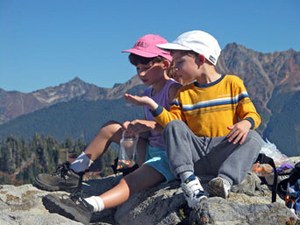
Successful Summer Hiking with Kids
Summer is the perfect opportunity to explore the great outdoors with your children and the experts at Washington State trails have some great advice and resources to maximize fun, safety and learning!
You don’t need to pack your hiking gear away when you have kids! Hiking is a fantastic way to combine quality family time with exercise and exploration of the natural world. If you were an avid hiker before children, hiking to you may have meant how fast you can hike, how far you can go, or bagging peaks. Warning: Hiking with children of any age is different in many ways.But this post will provide some great tips and tools to get you started.
Planning
First, you need to get your head in the 'hiking with kids' zone. It takes a little more planning to have a successful trip when little ones are along. Some suggestions:- Modify your goals: You may not reach the end of the trail. You may not even hike a mile! Be prepared to adjust your hike to the enjoyment and comfort level of children.
- Pack patience and flexibility: If you see a frog dart across the trail, be prepared to stop and wait to watch for that frog to dart across the trail again. Use teachable moments to explore the natural world.
- Know what features are ahead: For starter day hikes, choose short trails that do not have much elevation gain, but do have features like lakes, ponds, or waterfalls along the way. Children are fascinated with water.
- Dress for success: Check weather conditions before you head out the door. Children get cold much easier than adults, especially if they get wet. Be ready with an extra change of warm clothes.
What makes a good hike with children?
A good hike is one that appeals to a child’s sense of exploration and adventure. Every trail has some kind of adventure in it.- Look for discoveries along the way. Bring a magnifying glass and kid-friendly field guide.
- Teach kids to be good observers by looking for signs of wildlife (feathers on the ground, claw scratches on tree trunks, animal tracks, bird holes in dead trees, fur along the trail, slugs. Water striders on lakes, sand dollars along the beach, frogs in pond).
- Choose a trail with features that interest kids as destinations or turnaround spots.
- Remember a child’s sense of time. Have patience when they stop to ask questions. They may be seeing their first trillium or woodpecker.
- Put yourself in their boots. Their legs are short and it takes three of their steps for every one of yours. Let the kids set the pace.
- Call for rest stops before they ask for them and praise them for how well they are doing.
Other Tips and Tricks
- Create a checklist of essentials to use over and over again: First aid kit, sunscreen, bug spray, snacks, stuffed animal, extra clothes, special walking stick, etc.
- Energy stops - As in “when we get to the big tree ahead we’ll need to have an energy stop.” Snacks provide great motivation to keep kids moving on trail.
- Hike with a friend - as kids get older they would rather spend time with friends than with their family. Allow your child to invite a friend along. They can share a fun experience and entertain each other.
- Rotate leaders - When hiking with more than one child make sure that everyone gets to be a leader and set the pace.
- Keep kids occupied - visit our Keep Kids Entertained on Trail page for ideas!
Friday, July 6, 2012
Positive Discipline Strategy: Control vs. Cooperation
Are you trying to gain control over children or with children? Trying to
gain control over children is hard. It takes constant effort. You have
to be very vigilant to police the action of children so you can
implement your control tactics—usually punishment and rewards. You have
to catch children being “good” so you can reward them and catch them
being “bad” so you can mete out the punishment. It never ends—and what
happens when you are not around? If you are very good at being in
control over children what have they learned? Have they learned
self-discipline, respect for self and others, responsibility,
problem-solving skills, cooperation?
Trying to gain control over children is disrespectful and greatly decreases your chances of winning cooperation. Disrespectful methods invite distance and hostility, rebellion, revenge, sneakiness to avoid getting caught, or, worst of all, a child’s developing belief that, “I am a bad person.” On the other hand, respectful methods invite closeness, trust, and cooperation.
Winning Cooperation
The best way to make a connection and win children over is to be respectful. One of the best ways to be respectful is to “get into the child’s world” and express understanding of the child’s feelings. Showing empathy is not the same as condoning. A really nice touch is sharing a time when you might have felt the same. These are the steps to create the connection to increase the chances that you can work for correction because children are likely to listen to you AFTER they feel listened to.
Correction Does Not Involve Punishment
In can be so difficult for parents and teachers to think they are not doing their job if they don’t engage in a lecture or some kind of consequence (usually a poorly disguised punishment). This will take you right back to the consequences (resistance and/or rebellion) you will experience by trying to gain control over instead of with your children. What do children learn when they are respectfully involved in finding a solution that works for everyone? Thinking skills, problem-solving skills, respect for self-and others, self-discipline, responsibility, listing skills, motivation for following the solution they have helped create. The list could go on and on. And, what better way to achieve control with, and to win cooperation. Once you have achieved a connection you have created an atmosphere where you can focus on a solution together. You have won cooperation.
Trying to gain control over children is disrespectful and greatly decreases your chances of winning cooperation. Disrespectful methods invite distance and hostility, rebellion, revenge, sneakiness to avoid getting caught, or, worst of all, a child’s developing belief that, “I am a bad person.” On the other hand, respectful methods invite closeness, trust, and cooperation.
Winning Cooperation
The best way to make a connection and win children over is to be respectful. One of the best ways to be respectful is to “get into the child’s world” and express understanding of the child’s feelings. Showing empathy is not the same as condoning. A really nice touch is sharing a time when you might have felt the same. These are the steps to create the connection to increase the chances that you can work for correction because children are likely to listen to you AFTER they feel listened to.
Correction Does Not Involve Punishment
In can be so difficult for parents and teachers to think they are not doing their job if they don’t engage in a lecture or some kind of consequence (usually a poorly disguised punishment). This will take you right back to the consequences (resistance and/or rebellion) you will experience by trying to gain control over instead of with your children. What do children learn when they are respectfully involved in finding a solution that works for everyone? Thinking skills, problem-solving skills, respect for self-and others, self-discipline, responsibility, listing skills, motivation for following the solution they have helped create. The list could go on and on. And, what better way to achieve control with, and to win cooperation. Once you have achieved a connection you have created an atmosphere where you can focus on a solution together. You have won cooperation.
Subscribe to:
Posts (Atom)