Are your kids excited to head back to school, yet dreading the same only PB&J in their lunchbox? Try one of these exciting, healthy lunch ideas from Real Simple as you send your kids back to the classroom.
1. Classic Chicken Soup
2. Pasta with Peppers and Mozzarella
3. Thumpers Wrap Sandwich
Tuesday, August 20, 2013
Monday, August 12, 2013
Back to School Transition Tips
Getting a new school year off to a good start can influence children’s attitude, confidence, and performance both socially and academically. The transition from August to September can be difficult for both children and parents. Here are a few suggestions to help ease the transition and promote a successful school experience from the NASP (National Association of School Psychologists).
Good physical and mental health. Be sure your child is in good physical and mental health. Schedule doctor and dental checkups early. Discuss any concerns you have over your child’s emotional or psychological development with your pediatrician. Your doctor can help determine if your concerns are normal, age-appropriate issues or require further assessment. Your child will benefit if you can identify and begin addressing a potential issue before school starts. Schools appreciate the efforts of parents to remedy problems as soon as they are recognized.
Review all of the information. Review the material sent by the school as soon as it arrives. These packets include important information about your child’s teacher, room number, school supply requirements, sign ups for after-school sports and activities, school calendar dates, bus transportation, health and emergency forms, and volunteer opportunities.
Mark your calendar. Make a note of important dates, especially back-to-school nights. This is especially important if you have children in more than one school and need to juggle obligations. Arrange for a babysitter now, if necessary.
Make copies. Make copies of all your child’s health and emergency information for reference. Health forms are typically good for more than a year and can be used again for camps, extracurricular activities, and the following school year.
Buy school supplies early. Try to get the supplies as early as possible and fill the backpacks a week or two before school starts. Older children can help do this, but make sure they use a checklist that you can review. Some teachers require specific supplies, so save receipts for items that you may need to return later.
Re-establish the bedtime and mealtime routines. Plan to re-establish the bedtime and mealtime routines (especially breakfast) at least 1 week before school starts. Prepare your child for this change by talking with your child about the benefits of school routines in terms of not becoming over tired or overwhelmed by school work and activities. Include pre-bedtime reading and household chores if these were suspended during the summer.
Turn off the TV. Encourage your child to play quiet games, do puzzles, flash cards, color, or read as early morning activities instead of watching television. This will help ease your child into the learning process and school routine. If possible, maintain this practice throughout the school year. Television is distracting for many children, and your child will arrive at school better prepared to learn each morning if he or she has engaged in less passive activities.
Visit school with your child. If your child is young or in a new school, visit the school with your child. Meeting the teacher, locating their classroom, locker, lunchroom, etc., will help ease pre-school anxieties and also allow your child to ask questions about the new environment. Call ahead to make sure the teachers will be available to introduce themselves to your child.
Minimize clothes shopping woes. Buy only the essentials. Summer clothes are usually fine during the early fall, but be sure to have at least one pair of sturdy shoes. Check with your school to confirm dress code guidelines. Common concerns include extremely short skirts and shorts, low rise pants, bare midriffs, spaghetti strap or halter tops, exposed undergarments, and clothing that have antisocial messages.
\Designate and clear a place to do homework. Older children should have the option of studying in their room or a quiet area of the house. Younger children usually need an area set aside in the family room or kitchen to facilitate adult monitoring, supervision, and encouragement.
Select a spot to keep backpacks and lunch boxes. Designate a spot for your children to place their school belongings as well as a place to put important notices and information sent home for you to see. Explain that emptying their backpack each evening is part of their responsibility, even for young children.
Freeze a few easy dinners. It will be much easier on you if you have dinner prepared so that meal preparation will not add to household tensions during the first week of school.
Tuesday, July 30, 2013
Want to Improve Your Child's Health........Get Outdoors
Before your kids head back to the classroom, the experts at National Wildlife Federation encourage us to get our little people outdoors!
Remember playing outside until mom called you in for dinner? Today’s kids probably won’t.
In the last two decades, childhood has moved indoors. The average American boy or girl spends as few as 30 minutes in unstructured outdoor play each day, and more than seven hours each day in front of an electronic screen.1,2,3
This shift inside profoundly impacts the wellness of our nation’s kids. Childhood obesity rates have more than doubled the last 20 years; the United States has become the largest consumer of ADHD medications in the world; and pediatric prescriptions for antidepressants have risen precipitously.4,5,6
Our kids are out of shape, tuned out and stressed out, because they’re missing something essential to their health and development: connection to the natural world.
Remember playing outside until mom called you in for dinner? Today’s kids probably won’t.
In the last two decades, childhood has moved indoors. The average American boy or girl spends as few as 30 minutes in unstructured outdoor play each day, and more than seven hours each day in front of an electronic screen.1,2,3
This shift inside profoundly impacts the wellness of our nation’s kids. Childhood obesity rates have more than doubled the last 20 years; the United States has become the largest consumer of ADHD medications in the world; and pediatric prescriptions for antidepressants have risen precipitously.4,5,6
Our kids are out of shape, tuned out and stressed out, because they’re missing something essential to their health and development: connection to the natural world.
Body
- Outdoor play increases fitness levels and builds active, healthy bodies, an important strategy in helping the one in three American kids who are obese7 get fit.
- Spending time outside raises levels of Vitamin D, helping protect children from future bone problems, heart disease, diabetes and other health issues.8
- Being out there improves distance vision and lowers the chance of nearsightedness.9
Mind
- Exposure to natural settings may be widely effective in reducing ADHD symptoms.10
- Schools with environmental education programs score higher on standardized tests in math, reading, writing and listening.11
- Exposure to environment-based education significantly increases student performance on tests of their critical thinking skills.12
Spirit
- Children’s stress levels fall within minutes of seeing green spaces.13
- Play protects children’s emotional development whereas loss of free time and a hurried lifestyle can contribute to anxiety and depression.14
- Nature makes you nicer, enhancing social interactions, value for community and close relationships.15
Wednesday, July 24, 2013
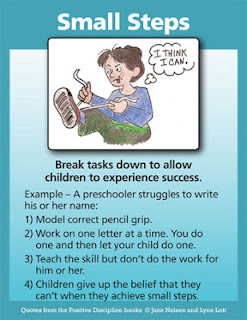
Small Steps
The folks at Positive Discipline share their strategies for teaching children to accomplish challenging tasks on their own, through this recent blog posting on “small steps.”
Parents may not realize that doing
too much for children (usually in the name of love) is discouraging. A child
may adopt the belief "I’m not capable” when adults insist on doing things
for him that he could do himself. Another possible belief is “I am loved only
when others are doing things for me.”
It may be helpful to remember that self‐esteem comes from having skills, and that pampering a child actually discourages him. Stop doing things for your child that he can do for himself and make room for him to practice—even when he does things imperfectly. When he says, “I can’t,” have patience; say, “I have faith that you can handle this task.” Break tasks into smaller steps so that the child can have multiple successes and to reduce feelings of frustration.
Encouraging a child who believes that he is inadequate requires a great deal of patience, gentle perseverance, and faith in the child’s abilities, but the rewards will be reaped in the future as you help to raise a confident, determined adult!
It may be helpful to remember that self‐esteem comes from having skills, and that pampering a child actually discourages him. Stop doing things for your child that he can do for himself and make room for him to practice—even when he does things imperfectly. When he says, “I can’t,” have patience; say, “I have faith that you can handle this task.” Break tasks into smaller steps so that the child can have multiple successes and to reduce feelings of frustration.
Encouraging a child who believes that he is inadequate requires a great deal of patience, gentle perseverance, and faith in the child’s abilities, but the rewards will be reaped in the future as you help to raise a confident, determined adult!
Parents
may not realize that doing too much for children (usually in the name
of love) is discouraging. A child may adopt the belief "I’m not capable”
when adults insist on doing things for him that he could do himself.
Another possible belief is “I am loved only when others are doing things
for me.” - See more at:
http://blog.positivediscipline.com/#sthash.Ml1W2nef.dpuf
Parents
may not realize that doing too much for children (usually in the name
of love) is discouraging. A child may adopt the belief "I’m not capable”
when adults insist on doing things for him that he could do himself.
Another possible belief is “I am loved only when others are doing things
for me.”
It may be helpful to remember that self‐esteem comes from having skills, and that pampering a child actually discourages him. Stop doing things for your child that he can do for himself and make room for him to practice—even when he does things imperfectly. When he says, “I can’t,” have patience; say, “I have faith that you can handle this task.”
Encouraging a child who believes that he is inadequate requires a great deal of patience, gentle perseverance, and faith in the child’s abilities.
- See more at: http://blog.positivediscipline.com/#sthash.Ml1W2nef.dpuf
It may be helpful to remember that self‐esteem comes from having skills, and that pampering a child actually discourages him. Stop doing things for your child that he can do for himself and make room for him to practice—even when he does things imperfectly. When he says, “I can’t,” have patience; say, “I have faith that you can handle this task.”
Encouraging a child who believes that he is inadequate requires a great deal of patience, gentle perseverance, and faith in the child’s abilities.
- See more at: http://blog.positivediscipline.com/#sthash.Ml1W2nef.dpuf
Parents
may not realize that doing too much for children (usually in the name
of love) is discouraging. A child may adopt the belief "I’m not capable”
when adults insist on doing things for him that he could do himself.
Another possible belief is “I am loved only when others are doing things
for me.”
It may be helpful to remember that self‐esteem comes from having skills, and that pampering a child actually discourages him. Stop doing things for your child that he can do for himself and make room for him to practice—even when he does things imperfectly. When he says, “I can’t,” have patience; say, “I have faith that you can handle this task.”
Encouraging a child who believes that he is inadequate requires a great deal of patience, gentle perseverance, and faith in the child’s abilities.
- See more at: http://blog.positivediscipline.com/#sthash.Ml1W2nef.dpuf
It may be helpful to remember that self‐esteem comes from having skills, and that pampering a child actually discourages him. Stop doing things for your child that he can do for himself and make room for him to practice—even when he does things imperfectly. When he says, “I can’t,” have patience; say, “I have faith that you can handle this task.”
Encouraging a child who believes that he is inadequate requires a great deal of patience, gentle perseverance, and faith in the child’s abilities.
- See more at: http://blog.positivediscipline.com/#sthash.Ml1W2nef.dpuf
Parents
may not realize that doing too much for children (usually in the name
of love) is discouraging. A child may adopt the belief "I’m not capable”
when adults insist on doing things for him that he could do himself.
Another possible belief is “I am loved only when others are doing things
for me.”
It may be helpful to remember that self‐esteem comes from having skills, and that pampering a child actually discourages him. Stop doing things for your child that he can do for himself and make room for him to practice—even when he does things imperfectly. When he says, “I can’t,” have patience; say, “I have faith that you can handle this task.”
Encouraging a child who believes that he is inadequate requires a great deal of patience, gentle perseverance, and faith in the child’s abilities.
- See more at: http://blog.positivediscipline.com/#sthash.Ml1W2nef.dpuf
It may be helpful to remember that self‐esteem comes from having skills, and that pampering a child actually discourages him. Stop doing things for your child that he can do for himself and make room for him to practice—even when he does things imperfectly. When he says, “I can’t,” have patience; say, “I have faith that you can handle this task.”
Encouraging a child who believes that he is inadequate requires a great deal of patience, gentle perseverance, and faith in the child’s abilities.
- See more at: http://blog.positivediscipline.com/#sthash.Ml1W2nef.dpuf
Parents
may not realize that doing too much for children (usually in the name
of love) is discouraging. A child may adopt the belief "I’m not capable”
when adults insist on doing things for him that he could do himself.
Another possible belief is “I am loved only when others are doing things
for me.”
It may be helpful to remember that self‐esteem comes from having skills, and that pampering a child actually discourages him. Stop doing things for your child that he can do for himself and make room for him to practice—even when he does things imperfectly. When he says, “I can’t,” have patience; say, “I have faith that you can handle this task.”
Encouraging a child who believes that he is inadequate requires a great deal of patience, gentle perseverance, and faith in the child’s abilities.
- See more at: http://blog.positivediscipline.com/#sthash.Ml1W2nef.dpuf
It may be helpful to remember that self‐esteem comes from having skills, and that pampering a child actually discourages him. Stop doing things for your child that he can do for himself and make room for him to practice—even when he does things imperfectly. When he says, “I can’t,” have patience; say, “I have faith that you can handle this task.”
Encouraging a child who believes that he is inadequate requires a great deal of patience, gentle perseverance, and faith in the child’s abilities.
- See more at: http://blog.positivediscipline.com/#sthash.Ml1W2nef.dpuf
Friday, July 19, 2013
Hours of Fun in Just Minutes!
It is always nice to find quick and simple crafts made with everyday items. However, it is even better if they entertain kids for hours! These easy balloon people can be put together in 2-3 minutes and kids seem to love that they always land on their feet!
Materials
Light cardboard (old cereal box works great)
Balloon
Scissors, permanent markers
Procedure
1. Blow up a balloon and tie off with a knot
2. Cut a heart out of heavy cardboard. Size isn't super important, but should be in proportion to the balloon (see the picture for a general idea).
3. Punch a small hole at the pointy end of the heart and pull the balloon knot through. Tape to secure on the underside of the heart.
4. Let kids decorate their balloon people with a permanent marker
5. Toss your balloon person into the air and be amazed as they always land on their feet!
Tuesday, July 9, 2013
Ice Cube Painting
As temperature soar, try this "cool" new painting technique. Simply fill an ice tray with water and add a few drops of food coloring to each tray. When the cubes are half frozen, place a craft stick or straw in the middle for a handle and complete the freezing process! Send your kids outside (this can be pretty messy) to paint masterpieces as the summer temperatures melt beautiful designs!
Monday, July 1, 2013
Help Your Family Beat the Summer Heat
The summertime can be some of the best times of a child’s life. School is out of session, there are vacations, activities and day trips to give kids enough memories to last a lifetime. But summer can also be a dangerous time for children as well. When the temperatures get hot, it can bring about things like dehydration, sunburn and even sun stroke. The tips below can help you and your family stay safe and avoid the hidden dangers of summer.
BEAT THE HEAT
- Hydration is important in warm weather, especially in children. Make sure that your children are properly hydrated with water or sports drinks. Caffeinated beverages can have a dehydrating effect. Products like Pedialyte can be used to quickly rehydrate children.
- If you keep your windows open during the summer, be sure to install window guards to prevent the possibility of a child falling. Most are easy to install. Choose window guards with quick release buttons for emergencies. Don’t count on screens to prevent falls.
- Avoid the harmful effects of the sun’s rays by using sun screen. Check the label of your sunscreen. It should protect against both UVA and UVB rays. Don’t skip the sunscreen on cloudy days. Apply insect repellents after sunscreen for optimal results from both.
- Never leave children in cars unattended. The temperature in the cabin of a sitting vehicle can rise quickly. Children are especially prone to overheating. Remove them from the vehicle before worrying about groceries or packages.
- In the height of the summer heat, avoid planning strenuous or outdoor activities for midday. Instead, plan those activities for before 10 a.m. or after 4 p.m.
- Sunscreen may not be enough protection for your child. Consider dressing your children in hats and sunglasses before exposing them to prolonged sunlight. The eyes are just as susceptible to the sun’s rays as the skin.
- To help avoid bug problems, refrain from using heavily scented soaps, shampoos or other beauty products on your kids, which attract pests. Bright colors and flowered print clothing may also attract insects.
Subscribe to:
Posts (Atom)